California Home Buying: Down Payment Tips 2026
Real Estate, California Home Buying, Down Payment Assistance
California Home Buying Down Payment Requirements: What You Really Need in 2026
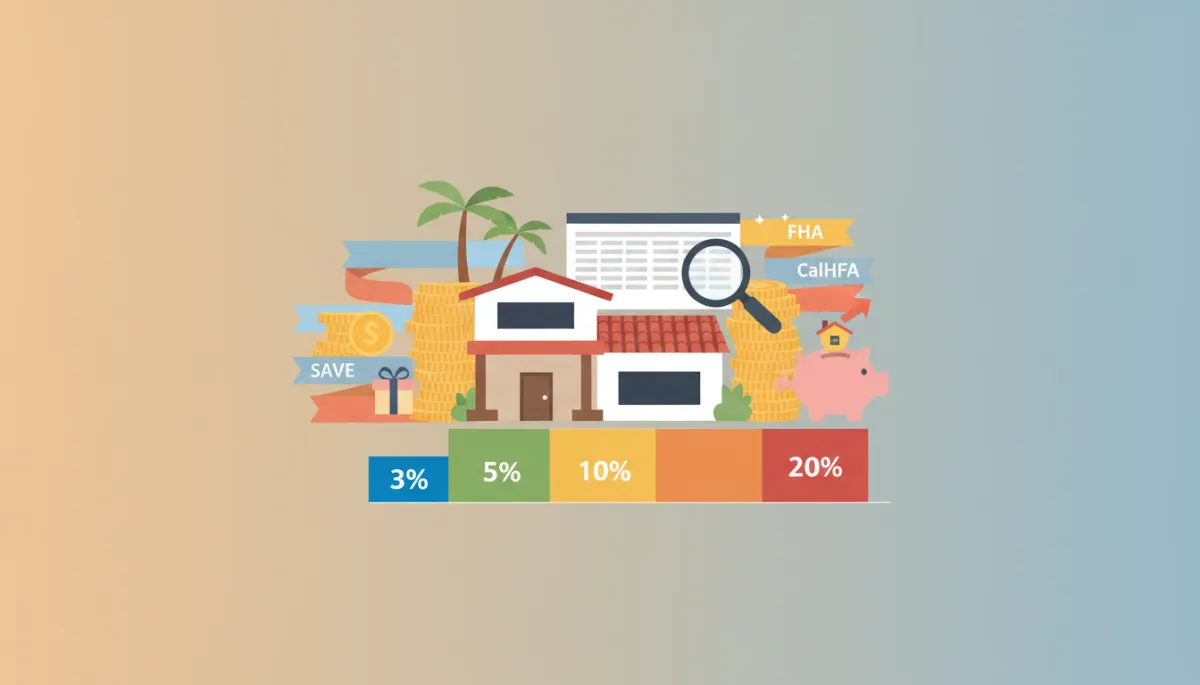
If you are shopping for a home in California, you have probably heard that you “need 20% down.” In reality, many buyers here purchase with far less—sometimes as little as 3%—especially when they combine smart loan choices with state down payment assistance. This guide breaks down how much you actually need, what 3%, 5%, 10%, and 20% down look like in real numbers, and how programs like FHA and CalHFA can help you get the keys sooner.

How Much Down Payment Do You Really Need in California?
Let’s start with the basics. For most California buyers using a conventional loan, lenders typically look for a down payment somewhere between 5% and 20% of the purchase price, according to the California Department of Real Estate and state financial regulators (dre.ca.gov, dfpi.ca.gov). However, many first-time buyers can qualify with as little as 3% down on certain conventional products if they meet income, credit, and debt-to-income guidelines.
At the same time, data from Redfin shows that typical buyers in pricey California metros like San Jose, San Francisco, and Anaheim often put down closer to 25% in practice, simply because home prices are high and many repeat buyers are rolling in equity. So while 3%–5% down is often possible, the “typical” down payment in these areas is higher than the national average of about 15% (Redfin, March 2026).
Comparing 3%, 5%, 10%, and 20% Down: What Changes?
To make this concrete, imagine a $700,000 starter home in a California suburb. Here is how different down payment levels change the picture:
- 3% down – That is $21,000. This is often the minimum for qualifying first-time buyers on some conventional loans. You will almost certainly pay private mortgage insurance (PMI), which adds a monthly fee until you build enough equity (usually when you reach around 20% equity).
- 5% down – That is $35,000. Still considered a low down payment, and PMI will apply, but your monthly payment may be slightly lower than with 3% down because you are borrowing a bit less and look a bit stronger to the lender.
- 10% down – That is $70,000. You still have PMI in most cases, but the premium is typically lower, and your monthly payment drops more noticeably. For many move-up buyers, this is a sweet spot between affordability and flexibility.
- 20% down – That is $140,000. This is the classic target because you usually avoid PMI completely, which can save hundreds of dollars per month. You also start with more equity, which can cushion you if prices fluctuate.
FHA Loans in California: 3.5% Down with Flexible Credit
If your credit history is not perfect, an FHA loan can be a friendly doorway into California homeownership. FHA loans are insured by the Federal Housing Administration and are especially popular with first-time buyers statewide. With a credit score of around 580 or higher, you may qualify for a down payment as low as 3.5% of the purchase price (NerdWallet, HUD).
FHA loans do come with mortgage insurance premiums (MIP)—both an upfront fee that is usually rolled into the loan and an annual premium built into your monthly payment. In return, you get more flexible credit guidelines and the ability to buy with a modest down payment, even in high-cost California markets (subject to county-specific FHA loan limits set by HUD).
CalHFA: Powerful Down Payment Assistance for Californians
One of the biggest advantages of buying in California is access to CalHFA (the California Housing Finance Agency) programs. These are designed to help first-time and first-generation buyers bridge the gap between what they have saved and what they need at closing.
MyHome Assistance Program: A “Silent Second” for 3%–3.5%
The MyHome Assistance Program offers a deferred-payment second loan, often called a “silent second,” that can cover part of your down payment and closing costs. In 2026, MyHome can provide:
- Up to 3% of the purchase price for conventional loans
- Up to 3.5% of the purchase price for FHA loans
You do not make monthly payments on this second loan right away. Instead, it is typically repaid when you sell, refinance, or pay off the first mortgage. To qualify, you need to be a first-time homebuyer, live in the home as your primary residence, stay under county income limits, and complete CalHFA-approved homebuyer education (calhfa.ca.gov).
Dream For All Shared Appreciation Loan: Up to 20% Help
For eligible first-time, first-generation buyers, CalHFA’s Dream For All Shared Appreciation Loan can be a game‑changer. Paired with a Dream For All conventional first mortgage, this program can provide up to 20% of the purchase price or appraised value, capped at $150,000, to use toward your down payment and closing costs (calhfa.ca.gov, 2026 program materials).
In exchange, you agree to repay the assistance plus a share of the home’s future appreciation when you sell, transfer, or refinance. Because funding is limited, CalHFA used a lottery-style application window in early 2026. If you are a real estate professional, it is worth tracking these windows so you can alert qualified clients early.
Other Specialized and Local Programs
CalHFA also partners on specialized offerings, like the UC Shared Appreciation Loan Program for eligible UC Santa Cruz employees, which can cover up to 20% (capped at $220,000) in select counties. Beyond CalHFA, local agencies may offer help through programs funded by CalHOME, HOME, or mortgage credit certificates. These are often administered by cities or counties, so checking with local housing departments can uncover hidden opportunities.
Using Gift Funds Toward Your Down Payment
Many California buyers get a boost from gift funds provided by family members or, in some cases, close friends or domestic partners. Lenders generally allow gifted money to count toward your down payment and closing costs, but they will require documentation to show that the funds are truly a gift, not a loan you must secretly repay.
- A signed gift letter stating the amount, the relationship, and that no repayment is expected
- Evidence of the donor’s ability to give the funds (for example, a bank statement)
- A clear paper trail showing the money moving into your account
Conventional and FHA loans both allow gift funds, but the exact rules about how much of your down payment can be gifted versus your own funds vary by loan type and occupancy. A California loan officer can walk you through the specifics for your situation.
Practical, California-Friendly Tips for Saving Your Down Payment
Even with assistance, most buyers need at least some of their own funds. Here are friendly, realistic strategies that work well for many Californians juggling rent, commuting costs, and everyday life:
- Set a specific target. Use online calculators to estimate how much you need for 3%, 5%, or 10% down on homes in your preferred area, plus closing costs. A clear number makes the goal feel more real and reachable.
- Create a separate “house fund.” Open a dedicated high‑yield savings account and set up automatic transfers every payday, even if it is only $100–$200 at first. Treat it like a non‑negotiable bill to your future self.
- Redirect windfalls. Tax refunds, bonuses, or side‑gig income can move the needle quickly when you send them straight to your down payment account instead of everyday spending.
- Trim “California lifestyle” extras. For a year or two, consider modest swaps: fewer weekend getaways, more meals at home, or a less expensive gym. You do not have to cut everything—just enough to free up a few hundred dollars a month.
- Explore house hacking. Some buyers plan to rent out a room or an ADU (where allowed) after closing. Knowing you will have that extra income may make a slightly higher payment or a shorter savings timeline feel more comfortable.
Bringing It All Together
In 2026, buying a home in California does not always require a 20% down payment. Depending on your income, credit, and home price, you may be able to purchase with:
- 3%–5% down on a conventional loan (with PMI)
- 3.5% down on an FHA loan, with flexible credit standards
- Additional help from CalHFA programs like MyHome or Dream For All, plus possible local or employer-based assistance
Layer in gift funds and a focused savings plan, and the path to homeownership in California becomes much more achievable than many people assume. Whether you are a hopeful buyer or a real estate professional guiding clients, the key is to start the conversation early, explore all the options, and build a clear, step‑by‑step plan toward the right down payment for your situation.
SEO Title: California Down Payment Requirements 2026: How Much You Really Need to Buy a Home
Meta Description: Learn how much down payment you need to buy a house in California in 2026. Compare 3%, 5%, 10%, and 20% down, explore FHA loans, CalHFA assistance, gift funds, and practical savings tips tailored to California homebuyers and real estate pros.