Temporary Buydown vs. Permanent Rate Buydown: Which Costs Less Over Time?
When you are buying a home, a lower first mortgage payment can make the move feel more manageable. But a lower payment can come from two very different tools: a temporary buydown that eases payments for a limited time, or discount points that permanently reduce the interest rate on the loan.

How a temporary buydown works
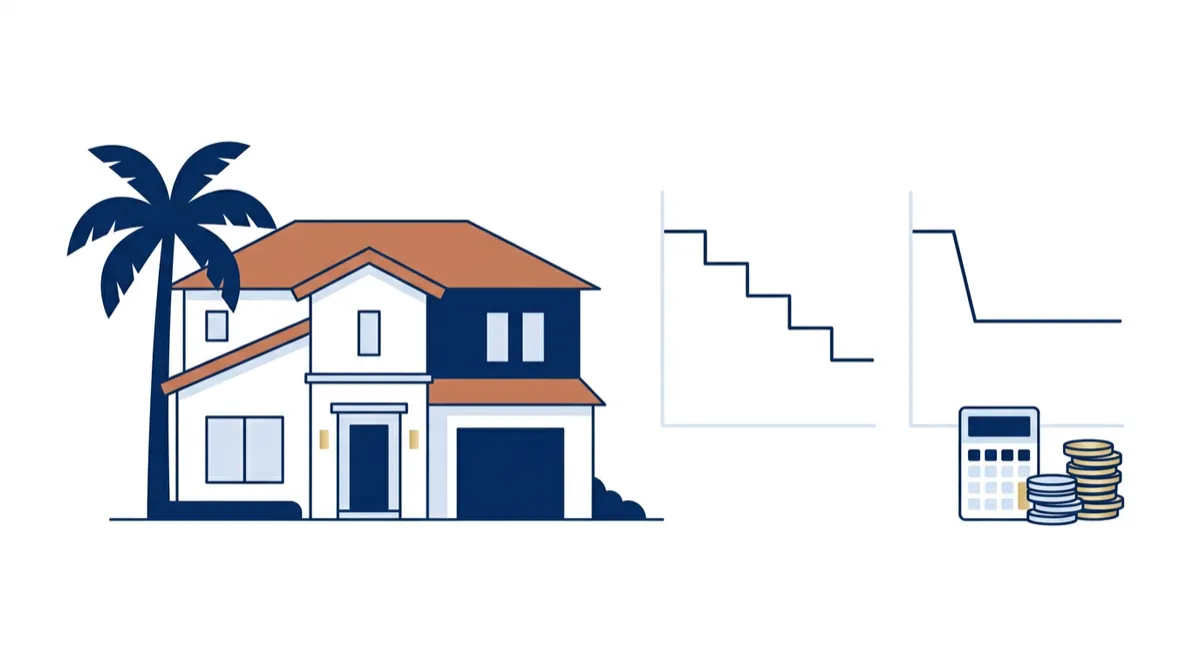
A temporary buydown uses money set aside at closing to subsidize some of your monthly principal-and-interest payment during the first year or years. The mortgage note keeps its stated rate; the buydown account covers the difference between the payment at that rate and the lower introductory payment. Once the subsidy period ends, your payment steps up to the scheduled payment at the note rate. It does not automatically change the note rate or promise that you will refinance.
Common structures include:
- 1-0: the payment is calculated at a rate one percentage point below the note rate for year one, then returns to the note-rate payment.
- 2-1: the payment starts two percentage points below the note rate in year one, one point below in year two, then returns to the note-rate payment.
- 3-2-1: the payment starts three points below the note rate in year one, two points below in year two, one point below in year three, then returns to the note-rate payment.
The seller, a home builder, or—in some loan structures—the lender through a credit may fund the subsidy. A buyer can sometimes contribute, too, if the loan program and transaction allow it. Credits are subject to program rules, eligible costs, contract terms, and lender review. Ask how the subsidy is funded and confirm the full payment schedule before comparing offers.
What permanent discount points do
Discount points are upfront charges paid to reduce the loan’s interest rate for its life, rather than only for an introductory period. A point typically costs 1% of the loan amount. As a broad illustration, one point may lower the rate by roughly 0.25%, but the actual reduction varies by lender and market. A quote should show the exact price, rate, and payment so you can judge the tradeoff.
Points may be paid by the buyer or, when permitted, covered with an eligible seller or builder credit. Paying points can be valuable if the resulting monthly savings last long enough to make up the upfront cost. If you sell or refinance before that break-even point, you may not recover what you paid.
A California illustration: $700,000 loan
Consider an illustrative $700,000, 30-year fixed-rate loan with a 6.50% note rate. At that rate, principal and interest (P&I) are about $4,424.48 per month. The following rounded amounts show how introductory payments could look if a temporary buydown is fully funded. They exclude property taxes, homeowners insurance, mortgage insurance, HOA dues, and other housing costs.
| Structure | Year 1 rate / P&I | Year 2 rate / P&I | Year 3 rate / P&I | After subsidy | Illustrative subsidy total |
|---|---|---|---|---|---|
| 1-0 | 5.50% / $3,974.52 | 6.50% / $4,424.48 | — | $4,424.48 | About $5,399 |
| 2-1 | 4.50% / $3,546.80 | 5.50% / $3,974.52 | 6.50% / $4,424.48 | $4,424.48 | About $15,932 |
| 3-2-1 | 3.50% / $3,143.31 | 4.50% / $3,546.80 | 5.50% / $3,974.52 | $4,424.48 | About $31,306 |
These subsidy totals are estimates based on the monthly P&I differences from the 6.50% payment over each reduced-payment year, using the same 30-year amortization for comparison. Actual program calculations, funding requirements, and quoted amounts may differ. The temporary payment is lower at first, but it steps up; plan for the full note-rate payment from the beginning.
Now compare a permanent buydown: suppose $7,000 (one point on this loan) lowers the rate from 6.50% to 6.25%. The estimated P&I payment at 6.25% is $4,310.02, a monthly reduction of about $114.46. Dividing $7,000 by $114.46 gives a simple break-even of roughly 61 months, or just over five years. This estimate ignores the time value of money, tax treatment, and differences in loan balance or loan term; it is a comparison tool, not a quote.
Which costs less over time?
There is no universal winner. A temporary buydown can be attractive when a seller or builder is offering a credit, you value extra breathing room in the first years, and you can comfortably afford the full payment after the subsidy ends. Its benefit is concentrated up front. A permanent buydown can become less expensive over a longer holding period because the lower payment continues, but the buyer or credit provider must cover the points at closing. In this example, a buyer who pays $7,000 in points needs to keep this same loan for about 61 months just to reach the simple payment-savings break-even.
If you expect to move or refinance sooner, points paid from your own funds may not have time to pay back. If you expect to keep the loan well past break-even, permanent points may deliver more cumulative payment savings. A temporary buydown funded by someone else can still be useful even for a shorter stay, but compare the credit against other uses and check whether the purchase price or other terms differ. Any future refinance depends on qualification, available rates, costs, and your circumstances; do not count on it as a certainty.
How agents can use seller credits
For agents, seller credits can be a practical negotiation tool when a buyer is payment-sensitive and the seller is open to concessions. Instead of focusing only on a price reduction, the parties can ask the lender to compare eligible options: closing-cost help, a temporary buydown, or—if permitted and priced appropriately—permanent discount points.
Keep the conversation grounded in the contract and lender’s numbers. Seller concessions and the use of credits are limited by loan-program rules and transaction details. Ask the lender to confirm the maximum credit, what costs it can cover, who will hold and administer any temporary subsidy, and what happens if the loan closes with unused funds. Agents should avoid promising a particular payment or future refinance outcome before the lender verifies the structure.
Quick checklist and FAQs
- Will my payment rise? With a temporary buydown, it is scheduled to rise as the subsidy steps down and then ends. With permanent points, the reduced note rate generally applies for the loan term, subject to the loan’s terms.
- Who pays? The buyer, seller, builder, or lender credit may fund eligible costs, depending on the program and agreement. Confirm the source and amount in writing with the lender.
- What if I refinance? A refinance may end the benefit of a temporary subsidy or stop future savings from points. Compare the remaining costs and savings rather than assuming a refinance will happen.
- What should I compare? Request the note rate, upfront cost, monthly P&I by year, full payment after any temporary subsidy, total credit used, and estimated break-even. Include cash reserves and likely time in the home.
Get a personalized comparison
If you are buying in California—or advising a California buyer—contact Kurt Kessler, a mortgage professional based in Chandler, Arizona, for a personalized comparison. Bring the estimated loan amount, available seller or builder credit, and how long you may keep the loan. He can help you review the payment path and costs for the options available to your transaction.
Disclaimer: All rates, payments, and costs here are illustrative estimates, not a rate quote, loan offer, or financial advice. Actual terms depend on the borrower, property, loan program, lender pricing, and market conditions. Confirm figures and eligibility with a qualified mortgage professional.