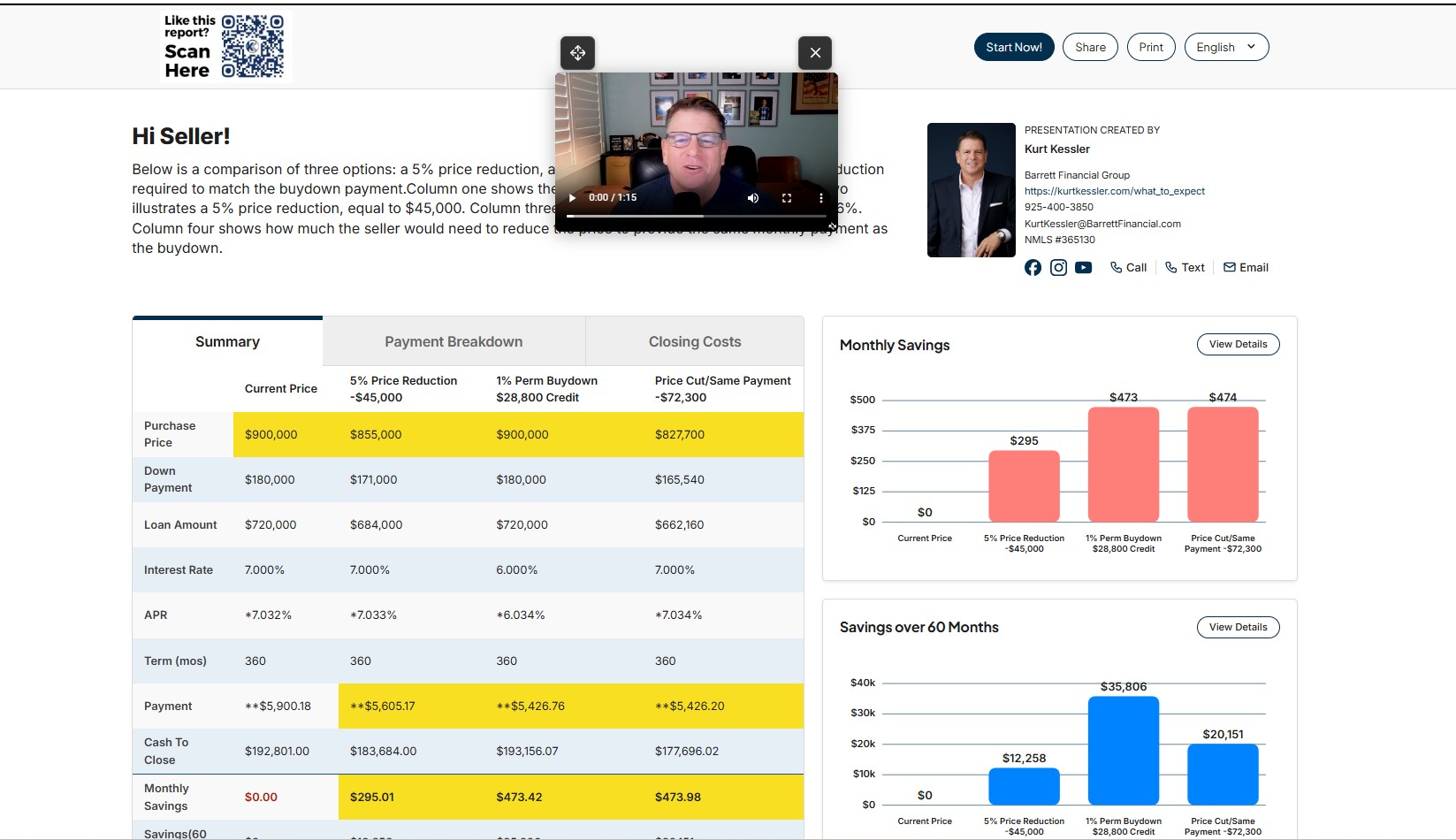
Permanent Rate Buydown vs. Price Reduction
Permanent Rate Buydown vs. Price Reduction: Which Creates More Value?
When a home is not attracting offers, the first instinct is often to reduce the price.
But is a price reduction always the best use of the seller’s money?
In many cases, offering a seller credit that the buyer can use for a permanent mortgage rate buydown may create a much larger reduction in the buyer’s monthly payment than an equivalent reduction in the purchase price.
What Is a Permanent Rate Buydown?
A permanent rate buydown uses discount points paid at closing to secure a lower interest rate for the life of the mortgage.
Unlike a temporary buydown, the interest rate and principal and interest payment remain lower for as long as the buyer keeps that loan.
The cost may be paid by the buyer, the seller through an allowable closing cost credit, or another eligible party, subject to loan program guidelines.
Why a Price Reduction May Have Less Impact Than Expected
A price reduction sounds attractive, but its effect on the monthly payment can be surprisingly small.
The buyer is not saving the entire amount of the price reduction each year. The reduction simply lowers the amount being financed, and that difference is spread over the full term of the mortgage.
For example, a seller might reduce the price by tens of thousands of dollars, yet the buyer’s monthly principal and interest payment may decline by only a few hundred dollars.
A permanent rate buydown takes a different approach. Instead of reducing the amount borrowed, it reduces the interest rate applied to the mortgage. Depending on current pricing, the loan program, and how long the buyer keeps the loan, this may produce greater monthly savings.
A Better Way to Compare the Options
Rather than automatically lowering the asking price, sellers and listing agents should compare:
The buyer’s payment at the current price and market interest rate
The payment after a traditional price reduction
The payment if an equivalent seller contribution is used for a permanent rate buydown
The break even period and potential long term savings
The loan program’s seller contribution limits and qualification requirements
You can view a side by side comparison here:
How This Can Help Sellers
A permanent rate buydown can become a powerful marketing strategy for a listing.
Instead of advertising only a lower price, the listing can highlight the potential for a reduced monthly payment. That may help the home stand out to payment conscious buyers without requiring the seller to make a larger price reduction.
This approach may help sellers:
• Attract more qualified buyers • Address monthly payment concerns • Differentiate the property from competing listings • Preserve more of the sales price • Create a stronger reason for buyers to act
The final benefit depends on the loan program, market rates, discount point pricing, appraisal, and the buyer’s qualifications.
How This Can Help Buyers
Buyers understandably focus on price, but the monthly payment often has a greater effect on affordability.
A lower permanent interest rate may provide:
• A lower principal and interest payment • Interest savings over the life of the loan • More predictable long term housing costs • Greater monthly cash flow • Less dependence on refinancing later
However, a permanent buydown is not automatically the right choice for everyone. If the buyer expects to sell or refinance relatively soon, there may not be enough time to recover the upfront cost. That is why the break even period should always be calculated before making a decision.
The Bottom Line
A price reduction changes the purchase price.
A permanent rate buydown changes the cost of financing for as long as the mortgage remains in place.
Both strategies can be valuable, but they do not create the same result. Before reducing the price, sellers and buyers should compare the actual monthly payment and long term financial impact of each option.
Sometimes the smartest price reduction is not a price reduction at all.
To learn more about permanent and temporary mortgage rate buydowns, visit:
Every loan scenario is different. Let’s run the numbers and determine which strategy creates the greatest benefit.
Cheers,
Kurt Kessler Senior Mortgage Broker NMLS #365130